
847. Shortest Path Visiting All Nodes
Đề Bài
You have an undirected, connected graph of n nodes labeled from 0 to n - 1. You are given an array graph where graph[i] is a list of all the nodes connected with node i by an edge.
Return the length of the shortest path that visits every node. You may start and stop at any node, you may revisit nodes multiple times, and you may reuse edges.
Example 1:
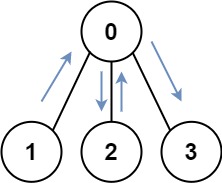
Input: graph = [[1,2,3],[0],[0],[0]]
Output: 4
Explanation: One possible path is [1,0,2,0,3]
Example 2:
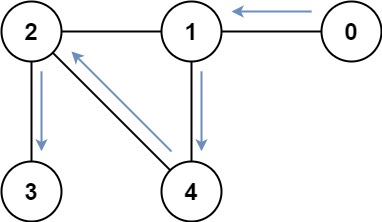
Input: graph = [[1],[0,2,4],[1,3,4],[2],[1,2]]
Output: 4
Explanation: One possible path is [0,1,4,2,3]
Constraints:
n == graph.length1 <= n <= 120 <= graph[i].length < ngraph[i]does not containi.- If
graph[a]containsb, thengraph[b]containsa. - The input graph is always connected.
Thuật Toán & Kỹ Thuật
⏱️ Thời gian
O(n×m)
💾 Không gian
O(n×m)
Lời Giải
C++
0847-shortest-path-visiting-all-nodes.cpp
class Solution {
public:
    int shortestPathLength(vector<vector<int>>& graph) {
        int n = (int)graph.size();
        vector<vector<bool>> dp(n, vector<bool>(1 << n, false));

        queue<tuple<int, int, int>> mq;

        for (int i = 0; i < n; ++i) {
            dp[i][1 << i] = true;
            mq.push({i, 1 << i, 0});
        }

        int res = (1 << n) - 1;

        while (!mq.empty()) {
            auto [u, mask, step] = mq.front();
            mq.pop();
            if (mask == res) {
                return step;
            }
            for (int v : graph[u]) {
                int maskV = mask | (1 << v);
                if (!dp[v][maskV]) {
                    mq.push({v, maskV, step + 1});
                    dp[v][maskV] = true;
                }
            }
        }

        return -1;
    }
};