
931. Minimum Falling Path Sum
Đề Bài
Given an n x n array of integers matrix, return the minimum sum of any falling path through matrix.
A falling path starts at any element in the first row and chooses the element in the next row that is either directly below or diagonally left/right. Specifically, the next element from position (row, col) will be (row + 1, col - 1), (row + 1, col), or (row + 1, col + 1).
Example 1:
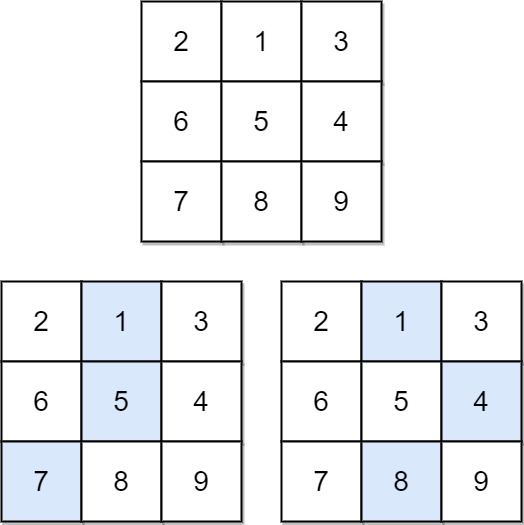
Input: matrix = [[2,1,3],[6,5,4],[7,8,9]]
Output: 13
Explanation: There are two falling paths with a minimum sum as shown.
Example 2:
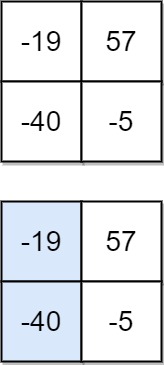
Input: matrix = [[-19,57],[-40,-5]]
Output: -59
Explanation: The falling path with a minimum sum is shown.
Constraints:
n == matrix.length == matrix[i].length1 <= n <= 100-100 <= matrix[i][j] <= 100
Thuật Toán & Kỹ Thuật
⏱️ Thời gian
O(n²)
💾 Không gian
O(n)
Lời Giải
C++
0931-minimum-falling-path-sum.cpp
class Solution {
public:
    int minFallingPathSum(vector<vector<int>>& matrix) {
        int n = matrix.size();

        for (int i = 1; i < n; ++i) {
            for (int j = 0; j < n; ++j) {
                matrix[i][j] += min({
                    matrix[i - 1][j],
                    matrix[i - 1][max(0, j - 1)],
                    matrix[i - 1][min(n - 1, j + 1)]
                });
            }
        }

        return *min_element(matrix[n - 1].begin(), matrix[n - 1].end());
    }
};
Python
0931-minimum-falling-path-sum.py
class Solution:
    def minFallingPathSum(self, matrix: List[List[int]]) -> int:
        n = len(matrix)

        for i in range(n - 2, -1, -1):
            for j in range(n):
                matrix[i][j] += min([
                    matrix[i + 1][j],
                    matrix[i + 1][max(j - 1, 0)],
                    matrix[i + 1][min(j + 1, n - 1)]
                ])

        return min(matrix[0])